
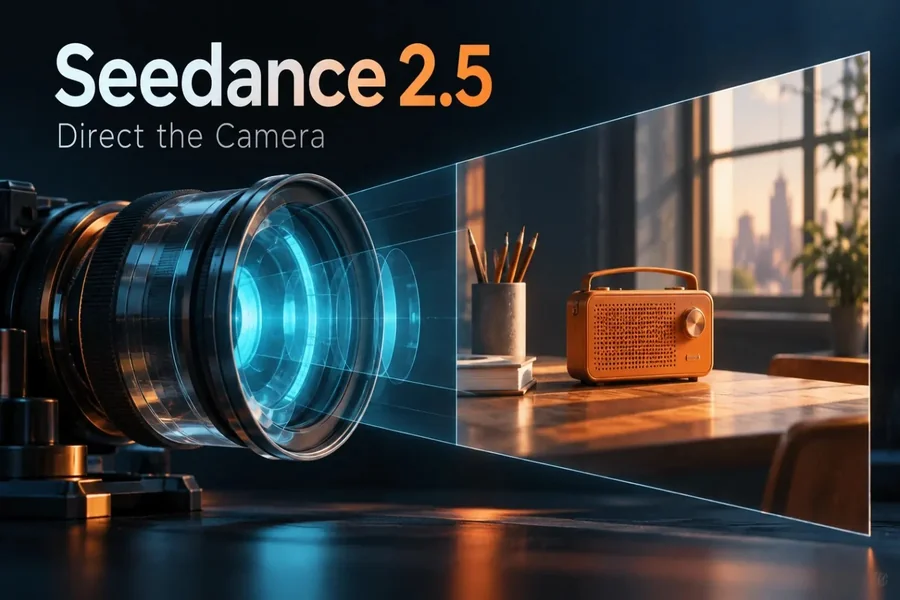
An orange radio sits on a desk, a pencil cup near the front edge and a window behind it. The instruction sounds simple: get closer to the radio. But there are two different shots hiding inside those words. One makes the existing view larger. The other takes the viewer further into the room.
That distinction matters when directing an AI video. A closer final frame might satisfy the literal request while missing the intended feeling. Is the viewer inspecting a detail from a fixed position, or approaching an object through a space? Choosing between those ideas gives the camera a job beyond making the subject bigger.
Why a closer view can still feel stationary
With a conventional zoom, the camera stays in place while the lens changes focal length. The frame tightens, but the viewing position remains the same. A digital enlargement offers another way to tighten an existing image, although cropping cannot uncover information outside that image.
A dolly-in moves the camera towards the subject. Its position changes, so the view of the surrounding space changes too. Nearby and distant objects do not simply enlarge as a single flat picture. Their relative sizes and alignments can shift.
Neither choice is automatically more cinematic. A zoom might suit a sudden discovery on the radio’s dial. A forward move might suit the quieter feeling of walking over to listen. The mistake is asking for one while judging the result against the other.
Seedance 2.5 Video Generator supports text-led generation and multimodal references, with prompts that describe camera direction. That gives this distinction a practical use: write the intended viewpoint change into the scene, rather than relying on the phrase “get closer” to carry the whole instruction.
Give the room three witnesses
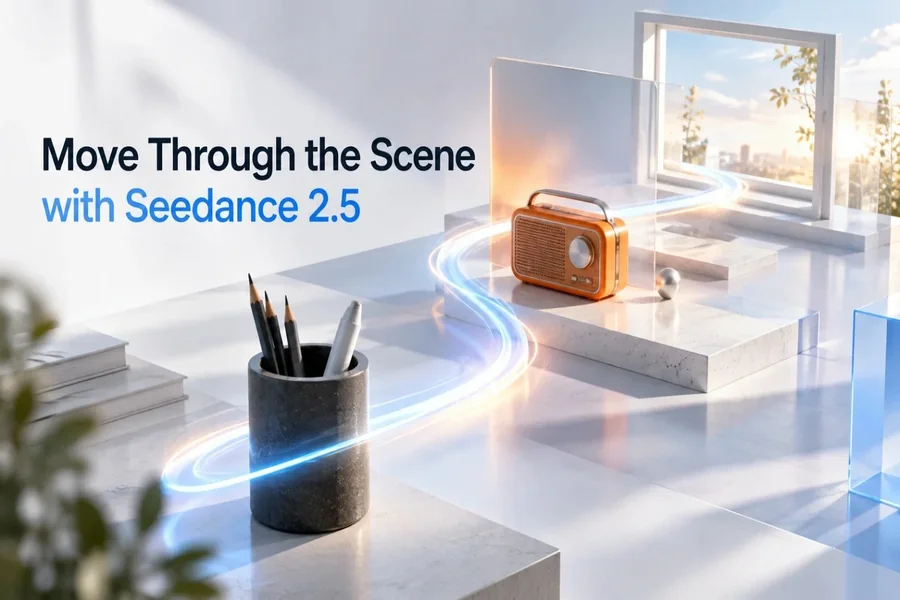
The radio alone is a poor witness. It gets larger in both kinds of shot. The pencil cup and window make the difference easier to read because they occupy different distances from the camera.
For this fictional exercise, place the cup off-centre, keep the radio in the middle distance, and leave a recognisable window edge behind it. There is no need for a crowded desk. A few distinct landmarks are more useful than a dozen objects competing for attention.
| Landmark | Question to ask while watching | What it helps distinguish |
| Radio body | Does it merely fill more of the frame? | A tighter view, but not proof of a moving viewpoint |
| Near pencil cup | Does its size or alignment change relative to the radio? | A possible cue that the viewpoint is travelling |
| Distant window edge | Does its relationship to the radio change plausibly? | Spatial change rather than uniform enlargement |
This is a viewing aid, not a measurement method. Generated motion can rearrange or deform objects. An apparent perspective shift therefore needs to be read alongside the stability of the scene, not accepted as evidence that the geometry is physically accurate.
Write two genuinely different instructions
It is tempting to write “slow cinematic zoom towards the radio” and assume that “towards” means travel. Separate the alternatives instead. These are suggested directions for an exercise, not tested outputs or guaranteed camera settings.
Fixed viewpoint: “A stationary orange radio on a desk. Keep the camera position fixed and slowly zoom in on the radio. The pencil cup and window stay still. End on a tighter view of the radio, without travelling through the room.”
Moving viewpoint: “A stationary orange radio on a desk, with a pencil cup closer to the camera and a window behind. Slowly move the camera forward towards the radio, without zooming. Let the changing viewpoint alter the relationships between the near cup, radio and distant window. End before reaching the radio.”
The important difference is the requested relationship, not the length of the prompt. Adding sweeping arcs, changing sunlight and a spinning radio would make it harder to tell which movement the viewer is actually seeing.
References can clarify the move, but cannot certify it
A scene image establishes what is in the room. A suitable video reference can communicate how the camera travels. Those are different pieces of information: an attractive still does not, by itself, specify whether the intended shot is a zoom, a forward move or an orbit.
Seedance 2.5 camera movement is easier to describe with a short reference showing a clear approach than with several clips containing conflicting directions. The service accepts video references alongside other inputs; the reference remains guidance rather than a promise of a mechanically identical camera path.
Use material eligible for upload and keep the requested scene distinct from the reference’s incidental details. If the reference shows a camera approaching a chair, the relevant idea may be its approach, not the chair, flooring or lighting. Spell that out so the direction does not become a request to reproduce an unrelated room.
Watch the space before admiring the finish
On the first viewing, ignore the pleasant colour grade. Follow the cup, radio and window. Does the room still make sense halfway through? Does the radio remain an object with a stable body, or does its outline stretch to accommodate the approach?
Seedance 2.5 provides a way to explore the intended shot, but the returned clip still decides whether the idea reads. A beautifully lit enlargement may be useful for a detail shot even if it does not resemble a dolly-in. Rename that choice honestly rather than treating every attractive result as proof that the original instruction worked.
For anything involving actual product dimensions or room clearance, keep measurements separate. A generated approach cannot establish how far the radio sits from the window or whether a piece of furniture will fit. Its usefulness here is expressive: showing how attention or proximity could feel.
Choose the ending by what the viewer learns
If the shot’s purpose is to reveal the dial, a tighter fixed view may be enough. If it is to make the viewer feel that they have crossed the desk towards the radio, the surrounding objects need to participate in that approach.
The last frame can look similar in both versions. The journey is what separates them. Ask what changed in the viewer’s relationship to the room, not only how large the radio became.

Hi, I’m Tony — a passionate blogger with over 3 years of experience in writing informative and accurate content. I specialize in sharing practical insights on sizes, measurements, and spatial guides to help readers make confident decisions. Through DimensionsPoint.com, I aim to simplify complex data into easy-to-understand content that’s reliable, useful, and SEO-friendly.
When I’m not writing, I’m researching the latest trends in measurement standards and user needs to keep my content relevant and up to date.