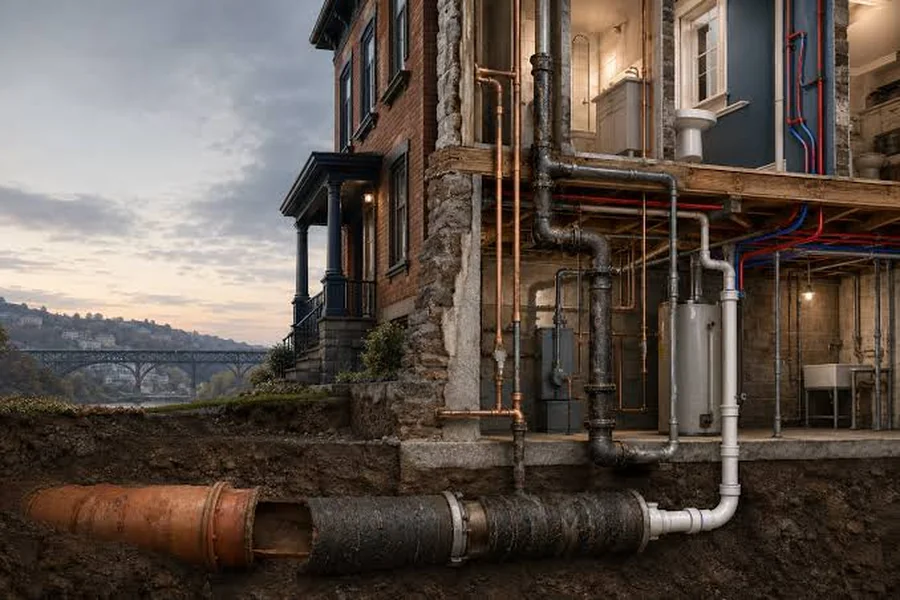
Most homeowners never think about the pipes hiding inside their walls until a ceiling starts dripping or water pressure drops without warning. But those pipes are one of the most revealing records of American construction history you’ll ever find. Every era brought a new material sold as the definitive answer, and almost every one of them eventually created a new set of problems for the owners who inherited them.
Understanding that history isn’t just interesting trivia. It tells you exactly what risk you might be sitting on right now, depending on when your house was built.
The Four-Era Pipe Timeline: A Framework for Understanding What’s in Your Walls
Plumbing material history in the U.S. breaks cleanly into four eras, each driven by a combination of manufacturing economics, post-war demand, and building code evolution. Knowing which era produced your home gives you an immediate starting point for any plumbing conversation.
Era 1: Lead and galvanized steel (pre-1940s). For the first century of widespread indoor plumbing, lead was the prestige material. It was soft enough to bend around obstacles, didn’t corrode on the outside, and held pressure reliably. Galvanized steel, coated in a thin layer of zinc, served as the economical alternative, especially for supply lines in working-class homes. The problem with galvanized pipe isn’t sudden failure. It’s slow accumulation. As the zinc layer oxidizes over decades, iron deposits build up on the interior walls. Water pressure gradually drops. The water that does come through picks up rust, discoloration, and a metallic taste. By the time a homeowner notices, the pipes are already severely restricted.
Era 2: Copper’s golden age (1950s through 1970s). After World War II, the copper industry had surplus manufacturing capacity and a housing boom to supply. Copper became the dominant residential pipe material almost overnight. It resisted corrosion far better than galvanized steel, carried both hot and cold water cleanly, and lasted long enough that many copper systems from the 1960s are still working today. By 2023, the U.S. housing stock had reached a median age of 44 years , according to the Harvard Joint Center for Housing Studies — which means the typical American home was built right at the tail end of the copper era. That copper is now old enough to develop pinhole leaks from pitting corrosion, a phenomenon where soft water or high water velocity slowly eats through the pipe wall from the inside out. A single pinhole might drip for months inside a wall before it becomes visible.
Era 3: The plastic experiment (1978 to 1995). Two intersecting forces pushed the industry toward plastic in the late 1970s: copper prices were climbing, and a generation of polymer chemists believed plastic could outperform metal for residential supply lines. Polybutylene, a gray or blue flexible plastic, was installed in an estimated 10 million American homes during this window. It was cheaper than copper, easier to run through tight spaces, and initially seemed to hold pressure without issue.
The failures started quietly in the mid-1980s and escalated sharply by the early 1990s. The core problem involved chlorine and chloramine, both common disinfectants in municipal water supplies. Over years of exposure, these chemicals reacted with the plastic at a molecular level, causing it to become brittle from the inside even though the pipe looked fine from the outside. That brittleness led to a documented pattern of sudden, unpredictable failures. Shell Oil Company ultimately paid over $1 billion in settlements covering 2.7 million affected homes. The settlement funds have long since closed, but the pipes themselves are still present in houses across the country.
“Although the production and installation of polybutylene pipes ceased in the mid-1990s, millions of homes still contain this material today.” — widely documented by plumbing and home inspection professionals across the industry
Era 4: PEX takes over (1996 to present). Cross-linked polyethylene, or PEX, is what the plastic era should have been. It resists chlorine degradation, flexes without cracking, doesn’t corrode, and is inexpensive enough to make full repipes financially practical for most homeowners. PEX is now the dominant material for new residential construction and for replacement projects in older homes. It’s not a perfect material, but no material in this list was. The brass fittings used with some early PEX systems developed dezincification problems, though this was a fitting issue rather than a pipe issue, and the industry adapted.
Why the Aging Housing Stock Means This History Is Still Active
The pipe material eras described above aren’t just history. They’re a map of active risk in the existing housing stock. More than 9 million existing lead service lines pose ongoing concerns, and the EPA determined that the nation’s water infrastructure needs stand at $625 billion over 20 years, according to the American Society of Civil Engineers’ 2025 Infrastructure Report Card. The projected gap between drinking water infrastructure needs and investments stood at $309 billion in 2024 alone. That funding picture shapes what municipal systems can do, and it puts more pressure on homeowners to manage their own internal plumbing proactively.
Consider a concrete scenario. A house built in 1985 in a Seattle suburb is statistically likely to have the original polybutylene supply lines, possibly with some copper mixed in where early repairs were made. The exterior looks fine. The pipes feel fine when you open the wall for a bathroom renovation. But that PB material has been bathing in chlorinated municipal water for forty years. The brittleness is internal and invisible. Selling that house without addressing the pipes is increasingly difficult, because home inspectors flag PB on sight and some insurers will either charge higher premiums or decline coverage. Companies like Repipe Masters have made entire businesses out of this exact situation, completing full residential repipes in a single day so homeowners aren’t left without water for days during a disruptive multi-stage plumbing overhaul.
How to Figure Out What’s in Your Walls Right Now
You don’t need a plumber to do preliminary identification. Here’s a reliable four-step process:
- Check your home’s build year. Pre-1940 strongly suggests galvanized or lead. 1978 to 1995 raises immediate polybutylene flags. Post-1996 is likely copper or PEX.
- Look at exposed pipes in the basement, utility room, or under sinks. Galvanized is dull silver-gray and often rusty at joints. Copper is unmistakably orange-brown. Polybutylene is gray or blue-gray and flexible. PEX is color-coded by temperature, usually red for hot and blue for cold.
- Check pipe markings. PB pipe is often stamped “PB2110.” PEX carries a manufacturer mark and an ASTM or NSF designation. If you see PB2110, treat the entire system as suspect, not just the visible section.
- Note your water pressure and color. Gradually declining pressure and rust-tinged water in an older home points to galvanized buildup. Sudden pressure drops or wet spots in walls with no obvious source point to pinhole leaks in copper or failing PB joints.
The Decision to Repipe: Repair vs. Replace
Spot repairs on failing pipe systems are a real option, but they carry a practical ceiling. Patching one polybutylene joint doesn’t address the chemical degradation that has already progressed through the rest of the run. Patching one pinhole in copper doesn’t tell you how many more are developing nearby. Most experienced plumbing professionals reach the same conclusion: once a system starts failing in multiple locations, or once the pipe material itself is identified as a known problem type, full replacement is almost always the better long-term investment.
The economics favor replacement more strongly than most homeowners expect. A full repipe adds immediate value to the home, removes it from the high-risk category that some insurers use to set premiums, and eliminates the unpredictable repair calls that accumulate over years of spot-fixing a deteriorating system. The one-day repipe model, where a specialized crew replaces the entire supply system in a single visit, removes the main practical objection most homeowners raise: the disruption of living in a construction zone for a week.
American homes carry their pipe history silently and faithfully. The question isn’t whether that history matters. It’s whether you know which chapter you’re living in.

Hi, I’m Tony — a passionate blogger with over 3 years of experience in writing informative and accurate content. I specialize in sharing practical insights on sizes, measurements, and spatial guides to help readers make confident decisions. Through DimensionsPoint.com, I aim to simplify complex data into easy-to-understand content that’s reliable, useful, and SEO-friendly.
When I’m not writing, I’m researching the latest trends in measurement standards and user needs to keep my content relevant and up to date.