
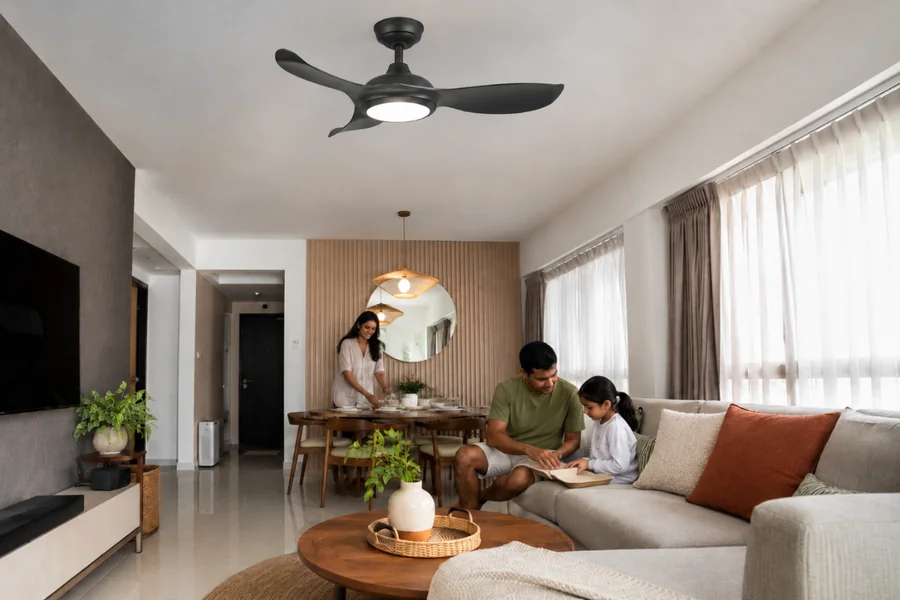
Ceiling fans have changed considerably from the simple pull-chain models that were once common in bedrooms and living rooms. Many newer designs combine airflow, LED lighting, remote controls, app connectivity, scheduling, and integration with other smart-home devices.
That extra functionality can be useful, but it can also make choosing a fan more complicated. A long feature list does not necessarily mean a better product. For most homeowners, the best smart ceiling fan is one that improves everyday comfort without adding unnecessary complexity.
Understanding which features actually matter can help separate practical upgrades from technology that may rarely be used.
What Makes a Ceiling Fan “Smart”?
A standard remote-controlled ceiling fan already allows users to change speed or operate a light without using a wall switch. A smart ceiling fan usually adds some form of connected control, commonly through a mobile app or compatible smart-home platform.
Depending on the model, this may allow users to:
- adjust fan speed from a phone
- switch or dim integrated lighting
- create operating schedules
- set timers
- save preferred settings
- control the fan through compatible voice assistants
- include the fan in wider home automation routines
Not every smart fan supports every function, so consumers should check the actual specifications instead of assuming that “smart” means full compatibility with every platform.
App Control: Useful or Just Another Remote?
App control is one of the most common smart features, and its usefulness depends largely on how the fan is used.
For a bedroom fan, being able to change the speed without getting out of bed can be genuinely convenient. In larger homes, app control may also make it easier to check whether a fan or light has been left on.
However, an app should not be the only practical way to operate the fixture. Physical wall controls or a handheld remote can still be valuable, particularly for guests or household members who do not want to use a phone every time they adjust the fan.
When comparing a smart ceiling fan with light, it is worth checking which controls are included and whether basic functions remain accessible without relying completely on an app.
Scheduling Can Be More Useful Than It Sounds
Scheduling is one of the smarter features that can provide real everyday value.
A bedroom fan might be programmed to operate before bedtime and turn off later in the night. In frequently used living areas, scheduled operation can help avoid leaving the fan running unnecessarily.
Timers can be particularly useful for people who prefer airflow while falling asleep but do not need the fan operating until morning.
The value here comes from convenience rather than novelty. A useful schedule should reduce the number of times users need to manually adjust the fixture.
Remote Control Still Matters
Smart connectivity does not make a traditional remote obsolete.
A remote-controlled ceiling fan can often provide the fastest way to adjust speed, lighting, or direction without opening an application or using a voice command.
For many households, the ideal setup includes several control methods:
- wall control for everyday use
- remote for convenience
- app control for scheduling and remote access
Having more than one practical option also means the fan remains easy to use if a phone is unavailable or a network connection is temporarily interrupted.
Integrated LED Lighting: Look Beyond the Word “LED”
A ceiling fan with an integrated light can be particularly practical when the room has only one central ceiling connection.
LED lighting also offers advantages in energy efficiency, long operating life, and compact fixture design. However, consumers should compare the lighting specifications just as carefully as the fan itself.
Important details include:
Brightness
Look for actual light output rather than simply assuming that an integrated LED module will illuminate the entire room adequately.
A bedroom may need less output than a home office or larger living area.
Color Temperature
Warm light often works well in bedrooms and relaxed living spaces, while neutral or cooler light may suit work areas better.
Some fixtures allow users to select or change color temperature, which can be useful in multipurpose rooms.
Dimming
Dimmable lighting provides significantly more flexibility than a fixed-output light.
Before buying, confirm whether dimming is supported and whether it can be controlled through the remote, app, wall switch, or all three.
Serviceability
It is also worth checking whether the LED component can be replaced or serviced if it eventually fails. Integrated lighting may look clean, but maintenance should still be considered when purchasing a fixture intended to remain installed for years.
Smart Features Should Not Distract From Fan Performance
Connectivity is useful, but a ceiling fan still needs to move air effectively.
Consumers should first consider fundamentals such as:
- room size
- blade span
- airflow performance
- ceiling height
- mounting style
- motor noise
A fan with an excellent app but poor airflow is unlikely to be satisfying in everyday use.
Noise deserves particular attention in bedrooms, offices, and other quiet spaces. A fan that will operate for several hours at a time should remain comfortable acoustically as well as physically.
Voice Control and Smart-Home Integration
Voice control can be convenient when hands are occupied or when several devices are already connected through one smart-home system.
For example, a compatible system may allow users to include the fan in an evening routine alongside lighting or other devices.
Before purchasing, check compatibility carefully. Terms such as “smart,” “Wi-Fi,” and “app controlled” do not automatically mean that a product works with the specific platform already used in the home.
For consumers comparing connected ceiling fan options, compatibility with existing controls and smart-home systems can be more important than the total number of advertised features.
Which Features Are Most Worth Paying For?
For many households, the most practically useful features are fairly straightforward:
- Reliable remote or app speed control
- Dimmable LED lighting
- Timers and scheduling
- Quiet motor operation
- Compatibility with existing smart-home systems
Features beyond these can still be useful, but their value depends heavily on personal routines.
Someone building a highly automated home may appreciate extensive integration. Another homeowner may be perfectly satisfied with a quiet fan, integrated LED light, and a good remote.
Choose the Fan First and the Smart Features Second
Smart controls can make a ceiling fan more convenient, but they should complement good fundamental design rather than compensate for weaknesses elsewhere.
Start with the room: determine the appropriate fan size, mounting method, airflow needs, and lighting requirements. Then decide which connected features would genuinely make the fixture easier to use.
For homeowners comparing modern fan designs, LEDLights.io offers ceiling fans with options including integrated LED lighting, remote controls, low-profile configurations, and smart functionality for different residential settings.

Hi, I’m Tony — a passionate blogger with over 3 years of experience in writing informative and accurate content. I specialize in sharing practical insights on sizes, measurements, and spatial guides to help readers make confident decisions. Through DimensionsPoint.com, I aim to simplify complex data into easy-to-understand content that’s reliable, useful, and SEO-friendly.
When I’m not writing, I’m researching the latest trends in measurement standards and user needs to keep my content relevant and up to date.