
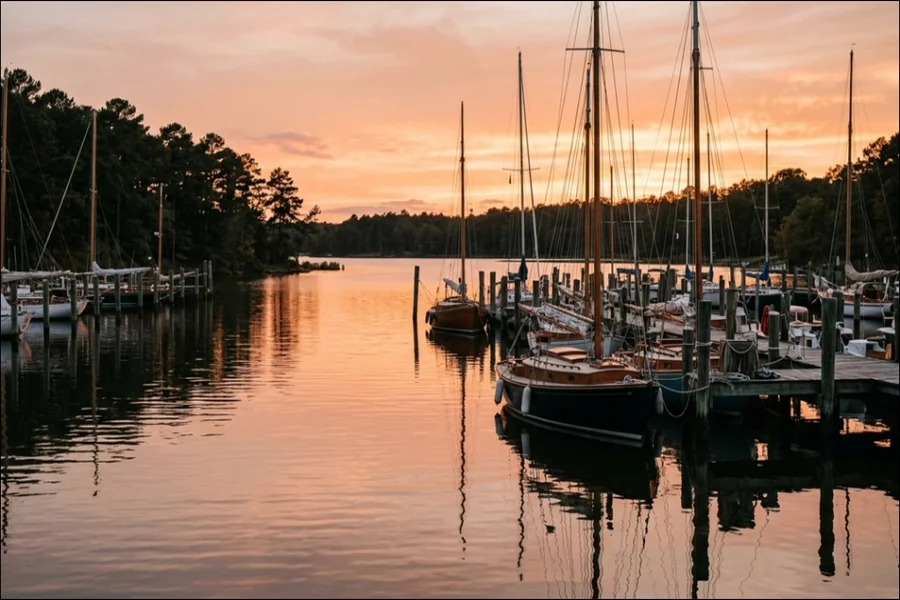
Maryland’s Eastern Shore has a different pace. The highway narrows, the pine trees thicken, and the Chesapeake Bay slides into view through the open fields.
Weekend visitors come here looking for calm water, old wooden docks, and towns small enough to walk end to end. It is a region that rewards patience, and travelers who linger a few extra hours.
St. Michaels: A Small Town Built Around the Water
St. Michaels sits on the Miles River and still carries the look of a nineteenth century shipbuilding village. Red brick storefronts line Talbot Street, and the harbor is active year round with workboats and private sailboats.
The Chesapeake Bay Maritime Museum is a reliable first stop. Its boatyard preserves classic wooden skipjacks and offers a close view of how watermen worked the Bay for generations.
Afternoons are made for walking the waterfront, stopping at the Hooper Strait Lighthouse, or picking up a cone at Justine’s. A short drive out to Tilghman Island reveals an even quieter stretch of road with crab shacks and sunset views.
Oxford and the Tred Avon Ferry
Across the Tred Avon River, the village of Oxford feels even smaller than St. Michaels. Fewer than seven hundred people live there, and its single main street ends at the water.
Oxford is a good place to find a bench, order a steamed crab platter, and watch the ferry cross back and forth. The Oxford Bellevue Ferry has been running continuously since 1683, which makes it one of the oldest in the country.
For visitors staying nearby, quiet retreats near the chesapeake coast make an easy base for a two or three day loop that strings together these towns without a long commute each morning.
Easton: Antiques, Galleries, and Longer Afternoons
Easton anchors Talbot County and acts as the shore’s cultural hub. Its restored Avalon Theatre hosts music and film year round, and the Academy Art Museum shows regional and national work.
The downtown blocks around Harrison Street are lined with antique shops, used bookstores, and small galleries. Saturdays bring a long running farmers market with Chesapeake produce, baked goods, and local honey.
Easton is a short drive from both St. Michaels and Oxford, which makes it a natural lunch stop or evening destination if a weekend plan needs more variety than a single village can provide.
Local Flavors Worth the Detour
Food on the Eastern Shore is tied to the Bay. Blue crabs, oysters, rockfish, and soft shell crab appear on nearly every menu from May through October.
Steamed crabs served on brown paper with Old Bay and vinegar remain the regional ritual. Diners pick slowly, talk between claws, and let an afternoon stretch into dusk.
In cooler months, oysters take over. Local raw bars pour sweet varieties from Hooper Strait and the Choptank River, often harvested that same morning. Pair them with a cold cider from an Eastern Shore orchard for the simplest meal in the region.
Rhythms of a Shore Weekend
The Eastern Shore does not reward tight itineraries. Mornings are for coffee on a porch and watching the water change color. Afternoons move at the speed of a short walk or a slow drive down a tree lined road.
Travelers who try to fit three towns and a museum into a single day usually leave feeling rushed. Those who build in long dinners and quiet mornings tend to return.
Fall is the shore’s quietest season, with clear light, migrating birds along the marshes, and shoulder season rates in most villages. Spring is close behind, with soft green fields and the first boats back on the water.
Getting Around
Most of the Eastern Shore is reached by car. From Washington, D.C. or Baltimore, the Bay Bridge is the main crossing, and traffic eases substantially past Kent Island.
Once across, the roads are narrow and scenic. Cell service dips in a few stretches, so downloaded maps and a loose plan work better than tight scheduling. The reward is a weekend that feels longer than the hours on the clock.

Hi, I’m Tony — a passionate blogger with over 3 years of experience in writing informative and accurate content. I specialize in sharing practical insights on sizes, measurements, and spatial guides to help readers make confident decisions. Through DimensionsPoint.com, I aim to simplify complex data into easy-to-understand content that’s reliable, useful, and SEO-friendly.
When I’m not writing, I’m researching the latest trends in measurement standards and user needs to keep my content relevant and up to date.