
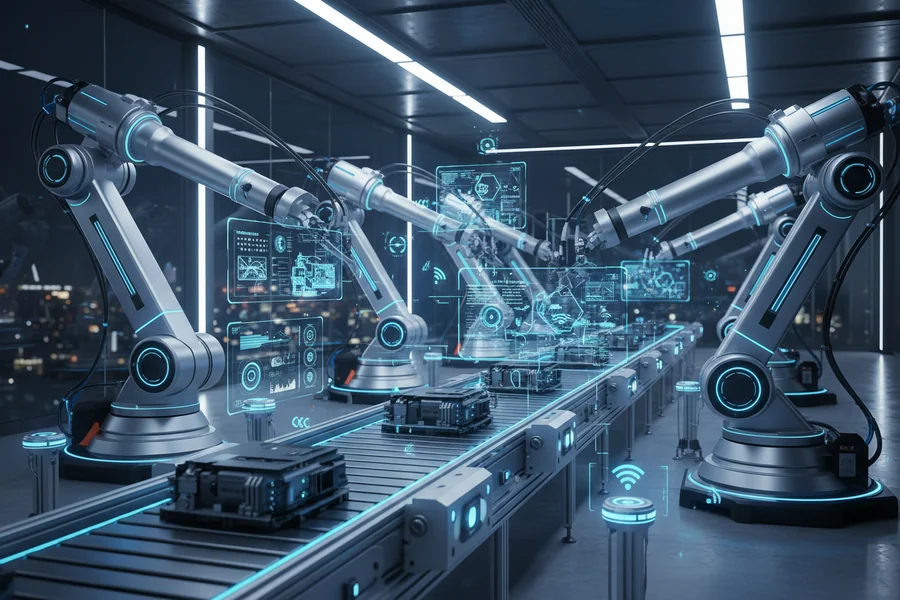
What if your manufacturing facility could move products and components along curved paths with the same speed and precision that traditional linear systems achieve on straight lines? Curved motion systems are reshaping how industries approach automation, offering manufacturers new possibilities for efficiency, flexibility, and design optimization. These advanced technologies enable smooth, continuous movement along arcs and complex trajectories, challenging the conventional reliance on linear motion combined with multiple directional changes. As factories face pressure to increase output while reducing waste and operational costs, curved motion systems have emerged as a significant competitive advantage.
1. Enhanced Product Flow and Reduced Bottlenecks
Curved motion systems dramatically improve the way materials and finished products move through manufacturing environments. Traditional automation typically relies on multiple linear sections connected at right angles, which requires stopping, repositioning, and restarting equipment at each transition point. With curved systems, products travel smoothly from one area to another without interruption, maintaining consistent speed and reducing mechanical stress on components. This seamless flow particularly benefits industries like automotive assembly, pharmaceutical packaging, and food processing, where product damage or production delays directly impact profitability. The elimination of abrupt directional changes also means less energy consumption at transition points, contributing to overall operational efficiency. By removing these bottlenecks, manufacturers can achieve higher throughput rates and more reliable production schedules.
2. Improved Precision and Quality Control
Modern curved motion systems deliver exceptional accuracy in positioning and movement, which directly translates to higher product quality and fewer defects. Unlike traditional systems where multiple adjustment points introduce cumulative alignment errors, curved pathways maintain consistent geometry throughout the entire motion sequence. This level of precision proves invaluable in electronics manufacturing and medical device production, where tolerances are extremely tight and defects can render entire batches unusable. The smooth, continuous curve motion also reduces vibration and shock loads that can compromise sensitive components or disrupt delicate processes. Quality control teams benefit from more predictable, repeatable operations that require fewer manual interventions and inspections. With improved precision, companies can reduce scrap rates, lower rework costs, and strengthen their reputation for reliability.
3. Space Optimization and Facility Design Flexibility
Curved motion systems enable manufacturers to design production layouts that would be impossible or impractical with traditional linear automation. Curved pathways allow equipment to fit into irregular spaces, work around building constraints, and reduce the overall footprint required for a complete production line. This flexibility proves especially valuable in older manufacturing facilities or urban locations where space comes at a premium and expansion is either impossible or prohibitively expensive. Engineers designing space-conscious production lines rely on curved linear rails for industrial applications to create custom arc trajectories that conform to irregular floor plans while sustaining the speed and load capacity that high-volume production demands. The ability to tailor curved trajectories means each facility can be optimized for its specific product mix, production volume, and spatial limitations. This design flexibility often leads to faster installation times, reduced construction costs, and easier line reconfiguration when production needs change.
4. Lower Maintenance Requirements and Extended Equipment Life
Curved motion systems typically require less maintenance than traditional automation setups because they eliminate the wear and tear associated with frequent stops, starts, and directional changes. Components experience more consistent loading patterns and stress levels when moving along smooth curved paths rather than enduring the shock impacts of abrupt transitions. The reduced mechanical stress extends the service life of both the motion control equipment and the products being transported, lowering replacement costs and minimizing production downtime. Predictable wear patterns also make it easier for maintenance teams to plan interventions and stock replacement parts strategically. Many modern curved motion systems include monitoring capabilities that track performance metrics and predict when maintenance will be needed before failures occur. This shift from reactive to predictive maintenance reduces unexpected breakdowns and the costs associated with emergency repairs and lost production time.
5. Scalability for Future Growth and Adaptation
Manufacturers can implement curved motion systems in ways that easily accommodate future production growth or changes in product specifications. As a company’s needs evolve, curved systems can be modified, extended, or reconfigured with relative ease compared to replacing entire traditional automation networks. This scalability makes curved motion technology an attractive long-term investment that protects automation infrastructure against obsolescence. Whether a manufacturer needs to increase production volume, add new product lines, or respond to shifting market demands, curved motion systems provide the flexibility to adapt without complete overhauls. The modular nature of many modern systems allows companies to add components and capabilities incrementally rather than committing to entirely new equipment. This approach aligns with lean manufacturing principles and allows companies to grow their automation infrastructure at a pace matched to actual business needs.
Conclusion
Curved motion systems represent a meaningful evolution in industrial automation technology, addressing long-standing challenges associated with traditional linear systems. By enabling smooth, continuous movement along complex pathways, these systems deliver tangible improvements in product flow, precision, facility design, maintenance requirements, and scalability. The transformation extends beyond simple operational improvements, fundamentally changing how manufacturers approach facility planning and production optimization. As more industries recognize the competitive advantages these systems provide, curved motion technology will likely become increasingly standard in modern manufacturing environments. Companies that adopt this technology position themselves to benefit from improved efficiency, reduced costs, and greater operational flexibility in an increasingly competitive global marketplace.

Hi, I’m Tony — a passionate blogger with over 3 years of experience in writing informative and accurate content. I specialize in sharing practical insights on sizes, measurements, and spatial guides to help readers make confident decisions. Through DimensionsPoint.com, I aim to simplify complex data into easy-to-understand content that’s reliable, useful, and SEO-friendly.
When I’m not writing, I’m researching the latest trends in measurement standards and user needs to keep my content relevant and up to date.