
Modern automation increasingly depends on compact motors that can deliver controlled rotation, high efficiency and reliable operation with limited maintenance. Conventional brushed motors remain useful for many applications, but their mechanical brushes and commutators introduce components that gradually wear during operation. Brushless technology addresses this limitation by replacing mechanical commutation with electronic switching.
A bldc motor is a brushless direct-current motor that uses electronic commutation to control the magnetic fields responsible for producing rotation. Instead of physically switching current through the rotating windings with brushes and a commutator, the motor relies on an electronic controller to energise its windings in the required sequence. RS Hong Kong categorises brushless motors alongside brushed and geared DC motor technologies, with products available across different voltage, speed, power and torque specifications.
Electromagnetic Principle of Operation
The underlying principle remains electromagnetic force.
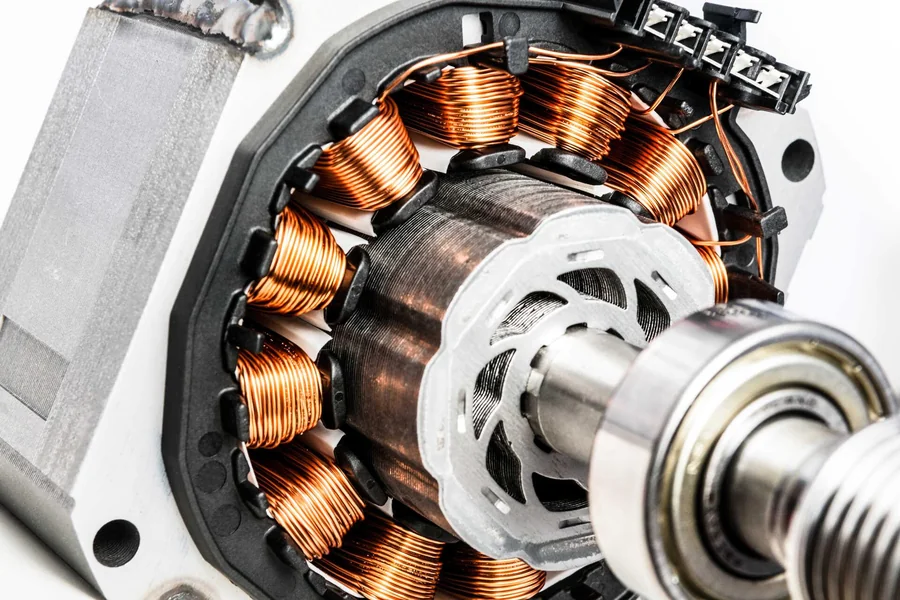
The motor contains stationary windings and a rotating magnetic assembly. When electrical current is applied to selected stator windings, a magnetic field is created. This field interacts with the permanent magnetic field of the rotor, producing torque.
The rotor continuously changes position as it turns. The controller therefore needs to change which windings are energised so that the magnetic field continues to produce useful torque in the direction of rotation.
This electronic switching process replaces the mechanical commutator used in conventional brushed motors.
The result is a motor architecture in which electrical control and mechanical motion are closely integrated.
Electronic Commutation
Electronic commutation is one of the defining characteristics of brushless motor technology.
A controller switches current between the motor phases according to the required commutation sequence. Rotor position information can be obtained through sensors or, in suitable control architectures, estimated electronically.
Hall-effect sensors are commonly used in sensor-based brushless systems to provide rotor-position information. The controller uses this information to determine when the next winding should be energised.
Sensorless systems instead estimate rotor position from electrical characteristics such as back electromotive force. This can reduce the number of physical components inside the motor, although the control algorithm becomes more complex, particularly at very low speeds.
Why Eliminating Brushes Matters
Mechanical brushes are contact components. As a brushed motor operates, the brushes physically interact with the commutator.
This creates friction and electrical wear. Arcing can also occur during switching, depending on motor design and operating conditions.
Removing these components can reduce mechanical wear and maintenance requirements. RS describes brushless motors as offering longer lifespan, minimal maintenance and higher efficiency, with the category guidance indicating efficiency around 85–90% for BLDC technology.
The absence of brushes also makes brushless technology attractive for applications where continuous operation or high rotational speed is required.
However, the electronic controller becomes an essential part of the overall system.
Speed and Torque Control
Motor speed and torque are central to selecting a brushless motor.
Speed is generally expressed in revolutions per minute, while torque describes the rotational force available at the shaft. The motor must provide sufficient torque to accelerate the load and maintain the required operating speed.
The controller regulates the electrical input to control motor behaviour. More sophisticated systems can use feedback to maintain a target speed despite changes in mechanical load.
RS Hong Kong lists brushless motors with substantially different output characteristics. For example, its category includes a 24 V RS PRO brushless motor rated at 0.9 Nm and 3700 rpm, as well as a 180 W, 24 V model rated at 4000 rpm.
These specifications demonstrate why motor selection needs to be based on the actual load profile rather than voltage alone.
Motor Voltage and Current
Supply voltage determines the electrical operating conditions of the motor and controller.
The RS Hong Kong category contains DC motor products using a wide variety of supply voltages, including common low-voltage systems such as 12 V and 24 V.
Current requirements are equally important because the motor may draw considerably more current during acceleration or high-load conditions than during steady-state operation.
The controller and power supply therefore need sufficient current capability for the intended operating conditions.
Thermal considerations should also be included because electrical losses eventually appear as heat within the motor and electronics.
Motor Construction and Thermal Management
Mechanical construction affects both performance and reliability.
The stator windings, rotor magnets, bearings, shaft and housing must work together to maintain the required air gap and rotational stability. Even small mechanical misalignments can influence vibration, noise and bearing loading.
Heat is another consideration. Copper losses in the windings and losses associated with the magnetic and mechanical components generate thermal energy.
A suitable housing can provide a path for heat to move away from internal components. The application’s ambient temperature, duty cycle and available airflow should therefore be considered when selecting the motor.
Gearboxes and Output Torque
High motor speed is not always desirable at the driven mechanism.
A gearbox can reduce rotational speed while increasing available output torque. This allows a compact motor to drive mechanisms requiring slower and more controlled movement.
RS Hong Kong lists both brushless and brushless-geared configurations within its broader DC motor range. Its product filters include gearhead type and gear ratio alongside output speed and maximum output torque.
This combination is useful in automation systems where the motor needs to operate efficiently while the final mechanism requires relatively low speed and higher torque.
Applications in Automation
Brushless technology is used across many automated systems.
RS identifies applications including fans, pumps and air compressors, while its wider DC motor guidance also covers factory automation, robotics, mobility systems, HVAC equipment and automated machinery.
In a robotic mechanism, electronic commutation can provide controlled movement without relying on mechanical brush contact. In a fan or pump, the ability to operate efficiently over extended periods can be particularly valuable.
The technology can also be combined with sensors, encoders and digital controllers to create closed-loop motion systems.
Closed-Loop Motion Control
A brushless motor can become part of a much larger control architecture.
An encoder can measure shaft position or speed, while a controller compares the measured value with the desired operating condition. The controller can then adjust motor commands to reduce the difference.
This feedback approach is useful when a system requires precise positioning, constant speed or controlled acceleration.
It also allows diagnostic information to be incorporated into automated equipment, helping identify abnormal speed, excessive load or other operating conditions.
Selecting the Appropriate Motor
Choosing a bldc motor requires evaluating the complete electrical and mechanical system.
Engineers should consider supply voltage, continuous and peak torque, operating speed, power rating, shaft diameter, mounting configuration, gearbox requirements, controller compatibility and environmental conditions.
The RS Hong Kong range provides specifications covering these parameters, including supply voltage, power rating, output speed, maximum output torque, shaft dimensions, current rating and gear ratio.
Brushless DC technology demonstrates how electronic control can replace mechanical commutation while improving the durability and controllability of rotating machinery. As automation systems become more compact and intelligent, the combination of efficient electromagnetic design, electronic switching, feedback sensors and digital motor control continues to make BLDC technology an important solution for modern motion systems.

Hi, I’m Tony — a passionate blogger with over 3 years of experience in writing informative and accurate content. I specialize in sharing practical insights on sizes, measurements, and spatial guides to help readers make confident decisions. Through DimensionsPoint.com, I aim to simplify complex data into easy-to-understand content that’s reliable, useful, and SEO-friendly.
When I’m not writing, I’m researching the latest trends in measurement standards and user needs to keep my content relevant and up to date.