
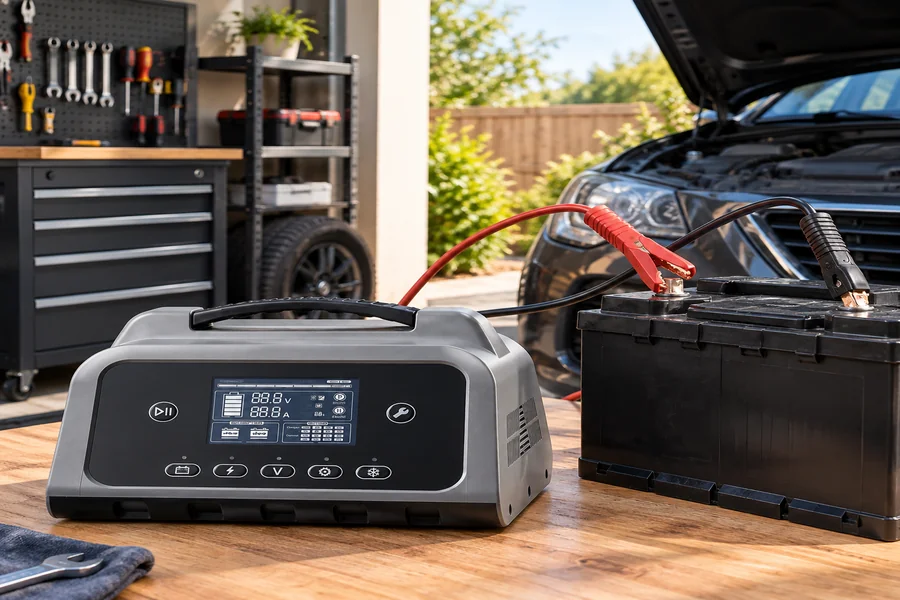
Your vehicle has been sitting for several weeks, and when you turn the key, you get nothing. The battery may simply be discharged, but the charger you use still matters. A charger with the wrong voltage, unsuitable battery mode, or excessive output can create problems instead of solving the original one.
Choosing a charger starts with identifying the battery in your vehicle and understanding how you plan to use the charger. Voltage compatibility, battery chemistry, charging current, automatic charging stages, maintenance capability, and safety features all affect whether a charger is suitable for the job.
A smart Battery Charger can automatically adjust the charging process as the battery’s condition changes, making it useful for both recovering discharged batteries and maintaining vehicles that are not driven regularly. The right choice, however, depends on matching the charger’s specifications to your battery rather than simply choosing the highest amperage available.
Check the Battery Voltage Before Buying
Voltage is the first specification to verify.
Most passenger vehicles use 12V batteries, while motorcycles and some smaller equipment may use 6V batteries. Larger vehicles and certain applications can use 24V systems.
Using a charger that does not support your battery’s voltage is an immediate compatibility problem. If you maintain different vehicles, a charger supporting multiple voltage levels can be more practical than purchasing separate units.
Check the battery label or vehicle documentation before connecting anything. Do not assume that every battery installed in a vehicle has the same requirements simply because the vehicle itself is familiar.
Match the Charger to the Battery Chemistry
Battery voltage is only part of the compatibility check. Different battery chemistries can require different charging profiles.
Common automotive battery types include:
- Lead-acid
- AGM
- Gel
- Lithium-ion, including LiFePO4
A charger designed specifically for one battery type should not automatically be used with another. The charging voltage and process can differ between chemistries.
Check the Battery Label First
Look at the battery casing for its type and charging information. If the label identifies the battery as AGM, Gel, LiFePO4, or another specific chemistry, choose a charger with a corresponding mode.
For a vehicle with a replacement battery that differs from the original specification, rely on the battery manufacturer’s requirements rather than assuming the vehicle’s original charging setup tells you everything you need to know.
Choose Charging Current Based on Battery Capacity
The charger’s amperage determines how quickly it can deliver current to the battery.
A high-current charger can be useful when you need to recharge a larger battery in less time, while a lower-current charger may be better suited to smaller batteries or long-term maintenance.
Do not choose amperage based solely on the idea that more power means faster and better charging. The appropriate charging current depends on the battery’s capacity and specifications.
For example, a small motorcycle battery does not have the same charging requirements as a large automotive battery. Similarly, a heavily discharged car battery may require a different charging approach from a battery that simply needs periodic maintenance.
Check the battery manufacturer’s recommended charging current and compare it with the charger’s available output before purchasing.
Look for Automatic Charging Stages
A smart charger should do more than continuously supply a fixed current.
Automatic charging systems can monitor the battery and adjust the charging process as the battery approaches a higher state of charge. Depending on the charger, this may include stages such as initial charging, absorption, and maintenance.
This matters when you plan to leave a vehicle connected for longer periods.
For example, a collector car, boat, motorcycle, or backup vehicle may sit unused for weeks or months. A charger with an appropriate maintenance mode can help keep the battery charged without requiring you to repeatedly start and stop the charging process manually.
A smart battery charger for cars with automatic charging and maintenance functions can be useful for this type of routine vehicle care.
Decide Whether You Need a Maintainer
A charger and a battery maintainer solve related but different problems.
If your vehicle’s battery is significantly discharged, you need a charger capable of delivering the appropriate charging current. If the battery is already charged but the vehicle sits unused for long periods, maintenance capability may be more important.
Consider a maintainer if you regularly store:
- Classic cars
- Motorcycles
- Boats
- Seasonal vehicles
- Lawn equipment
- Backup vehicles
The charger should be able to switch into an appropriate maintenance state rather than continuing to charge the battery at the same rate indefinitely.
Consider Desulfation Features Carefully
Some smart chargers include a desulfation or repair mode for compatible lead-acid batteries.
Sulfation can occur when lead-acid batteries remain undercharged for extended periods. Certain chargers use specialized charging cycles intended to address sulfation.
However, a desulfation mode is not a guarantee that an old or damaged battery can be restored. If the battery has a failed cell, severe physical damage, or has reached the end of its service life, changing the charging cycle will not turn it into a healthy battery.
Treat desulfation as an additional function, not as a reason to ignore battery testing or replacement.
Use the Display to Monitor the Charging Process
A built-in display can make troubleshooting easier.
Instead of connecting the charger and simply waiting, you can monitor information such as voltage, current, charging status, selected mode, or battery condition, depending on the charger.
This becomes particularly useful when diagnosing a vehicle that repeatedly develops a flat battery.
For example, if a battery is still struggling to maintain charge after a complete charging cycle, the problem may not be solved by simply leaving it connected longer. The battery itself, the vehicle’s charging system, or an electrical drain may need further investigation.
The display gives you useful information about what the charger is doing, but it should not be treated as a complete battery diagnostic system unless the manufacturer specifically states that it provides those functions.
Check the Safety Features
Battery charging involves electrical connections and, depending on the battery type, potentially hazardous conditions. Safety features should therefore be part of the selection process.
Look for protections such as:
- Reverse-polarity protection
- Short-circuit protection
- Overcurrent protection
- Overvoltage protection
- Overheating protection
- Spark or connection safeguards where specified
Automatic protection can reduce the consequences of common connection mistakes, but it does not replace correct installation.
Follow the charger and battery manufacturer’s instructions for connecting the terminals, selecting the charging mode, and positioning the equipment.
Choose a Charger That Fits Your Vehicles
If you only maintain one 12V car battery, you may not need every voltage and battery mode available.
If you work with several vehicles or types of equipment, versatility becomes more valuable.
For example, an automatic battery charger that supports multiple voltage levels and battery chemistries may cover more of your garage equipment with one unit.
Before buying a multi-purpose charger, verify the exact supported battery types and modes. A long list of compatibility claims is only useful if the charger’s actual charging profiles match the batteries you own.
Make the Compatibility Check Before Connecting
Before plugging in a charger, verify the battery voltage, chemistry, capacity, and the charging mode you intend to use.
Then check that the charger’s output is appropriate for that battery and that the connection procedure matches the manufacturer’s instructions.
A simple pre-connection check can prevent the most common selection errors:
- Confirm the battery voltage.
- Identify the battery chemistry.
- Check the recommended charging current.
- Select the correct charger mode.
- Confirm polarity before connecting.
- Check that the charger is suitable for the intended application.
If any specification is unclear, consult the battery or charger manufacturer’s documentation instead of guessing.
Choose Based on the Battery, Not the Feature List
A smart battery charger becomes useful when its charging profile matches the battery and the way you maintain your vehicle.
Start with voltage and chemistry. Then consider charging current, automatic charging stages, maintenance capability, monitoring, safety protections, and the number of vehicle types you need to support.
For occasional emergency charging, a straightforward compatible charger may be enough. For vehicles that sit unused or for owners maintaining several battery types, broader compatibility and automatic maintenance can make a bigger difference.
The right charger is ultimately the one that matches the battery’s requirements, provides the charging behavior you need, and gives you enough control and protection to use it safely.

Hi, I’m Tony — a passionate blogger with over 3 years of experience in writing informative and accurate content. I specialize in sharing practical insights on sizes, measurements, and spatial guides to help readers make confident decisions. Through DimensionsPoint.com, I aim to simplify complex data into easy-to-understand content that’s reliable, useful, and SEO-friendly.
When I’m not writing, I’m researching the latest trends in measurement standards and user needs to keep my content relevant and up to date.