
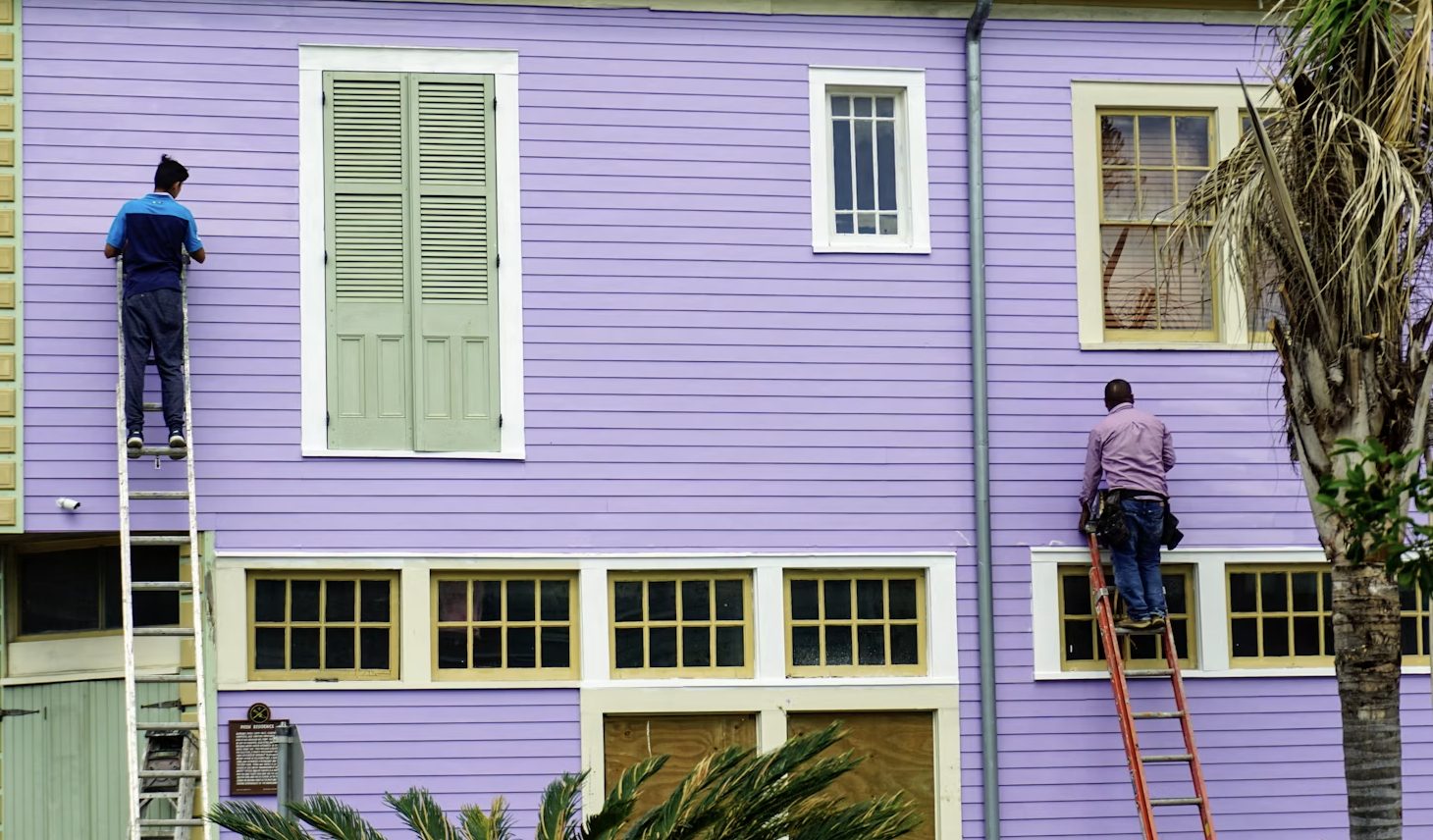
Exterior painting has a planning problem in northern Colorado. The window when conditions are right for quality work is shorter than in most of the country. The window when people notice the need for painting is longest during seasons when painting conditions are often wrong.
Understanding the timing constraints can lead to better results. It also helps prevent the early paint failures that can occur when exterior painting is done in the wrong season.
Why Timing Matters More in Fort Collins Than in Most Cities
Exterior paint needs three things to cure correctly: the right temperature, the right humidity, and enough time for each coat to dry before the next coat goes on.
Fort Collins delivers complications on all three fronts depending on the month.
Temperature. Most exterior latex paints require application temperatures above 50°F at the surface being painted. The surface temperature of north-facing walls or shaded areas drops below this limit well before air temperature does in fall and well after air temperature rises in spring.
Humidity. Paint applied in high humidity (above 85 percent) takes longer to dry and cures with reduced film integrity. Fort Collins’s summer monsoon season from mid-July through mid-August brings afternoon humidity spikes that require monitoring before every day’s work continues.
Wind. Fort Collins’s position between downslope and upslope wind corridors means wind events can carry airborne material. Paint applied on a moderately windy day with cottonwood season active (mid-May through early June) picks up seeds, dust, and debris in the wet film. These contaminants create defect sites in the cured film.
Painting Services Fort Collins CO from Distinct Painting Company schedules exterior work around these specific local constraints rather than using a generic schedule. The timing decision is made based on actual surface temperatures and local conditions rather than calendar month alone.
The Fort Collins Exterior Painting Calendar
| Month | Conditions | Recommended for Exterior |
| January | Surface temps often below 50°F, freeze risk | No |
| February | Variable, freeze risk continues | No |
| March | Possible on warm days, morning frost risk | Limited, check surface temp |
| April | Improving conditions, wind and rain variable | Yes, early morning work |
| May 1–15 | Good conditions, minimal cottonwood | Best spring window |
| May 15–June 10 | Cottonwood season, contamination risk | Avoid if cottonwood is active |
| June 10–July 15 | Good conditions, low humidity afternoons | Best early summer window |
| July 15–Aug 15 | Monsoon humidity spikes in afternoons | Morning work only |
| August 15–Sept 30 | Excellent conditions, low humidity, warm | Best fall window |
| October | Shortening days, freeze risk increasing | Limited, check surface temp |
| November–December | Surface temps consistently below 50°F | No |
What Happens When Paint Is Applied Outside the Window
Cold application (surface below 50°F):
Latex paint applied below 50°F does not form a proper film. The polymer particles in the paint coalesce by flowing together as water evaporates. Below 50°F, the polymers do not flow correctly. The film forms with gaps in the polymer matrix that reduce adhesion and leave the film porous.
The result is paint that peels within one to two seasons not because the paint is low quality but because the curing conditions were wrong for proper film formation.
Cottonwood contamination:
Cottonwood fibers that contact wet paint embed in the curing film as they dry. Each fiber creates a raised texture point and a pathway for moisture to wick into the film from the surface. These contamination sites become failure points as thermal cycling widens the micro-cracks around them over subsequent seasons.
Paint applied during active cottonwood dispersal in Fort Collins shows this pattern as a characteristic texture defect and early surface degradation that appears at 18 to 24 months post-application.
High humidity curing:
Paint applied when humidity exceeds 85 percent takes longer to release water vapor from the film. The water that remains in the film during curing plasticizes the polymer structure rather than leaving clean polymer bonds. The cured film has lower adhesion and lower hardness than the same paint cured at normal humidity.
What Substrate Preparation Determines More Than Paint Selection
The paint that goes on is only as good as what it goes on. Substrate preparation is where most early paint failures originate.
On previously painted surfaces:
Chalking from the old paint layer must be removed before new paint is applied. Chalk is a degraded binder. New paint is applied over chalk bonds to the chalk, which is not bonded to the substrate. The bond fails at the chalk layer.
TSP (trisodium phosphate) solution applied with a scrub brush and rinsed thoroughly removes chalk and provides a clean surface for new paint adhesion. This step takes time. It is skipped on low-bid paint jobs more than any other preparation step.
On bare wood:
Bare wood requires a primer before topcoat. Primer penetrates the wood surface and provides a bondable base for the topcoat. Topcoat applied directly to bare wood penetrates unevenly and produces an inconsistent film.
End grain sections of wood (top and bottom edges of boards, cut sections) absorb primer and paint at much higher rates than face grain. End grain sections require two or three primer coats before topcoat. A single primer coat on end grain leaves absorbency that the topcoat cannot bridge.
On stucco:
Hairline cracks in stucco must be filled with elastomeric caulk before painting. Standard paint does not bridge hairline cracks. When thermal movement opens the crack, paint painted over it tears rather than flexes.
Elastomeric caulk fills and bridges the crack with a flexible material that accommodates the movement.
What Fort Collins UV Does to Paint That Most Product Labels Do Not Account For
Fort Collins sits at 5,000 feet above sea level. The atmosphere at 5,000 feet contains approximately 17 percent less mass per column mile than at sea level. Less atmosphere means less UV filtration.
UV radiation breaks down the binder polymer in exterior paint through photolysis, light-driven breaking of chemical bonds. As bonds break, the binder weakens, the film chalks, and eventually cracks.
A paint rated for 15 years of exterior durability at ASTM D1006 test conditions performs that duration at sea level in moderate UV conditions. In Fort Collins’s high-altitude UV environment, the same paint on a south-facing surface delivers 10 to 11 years of comparable durability.
Paint formulations with HALS (Hindered Amine Light Stabilizer) chemistry handle this environment better than standard UV absorber formulations. HALS interrupts the photolysis chain reaction catalytically rather than absorbing UV until depleted. The protection regenerates as it works rather than declining as it absorbs.
For south-facing and west-facing surfaces in Fort Collins, HALS-containing formulations are the appropriate specification. They cost more than standard exterior paint. They outlast it by two to four years in Fort Collins’s UV conditions, making the cost-per-year lower.
Key Takeaways
- Surface temperature must exceed 50°F for correct latex paint film formation. Air temperature is not the same as surface temperature on shaded or north-facing walls
- The best exterior painting windows in Fort Collins are May 1–15, June 10–July 15 (mornings), and August 15–September 30
- Cottonwood season from approximately May 15 through June 10 creates contamination risk in wet paint films
- TSP washing to remove chalk from old paint layers is the most commonly skipped preparation step and one of the most consequential for adhesion
- HALS-containing paint formulations outlast standard UV absorber formulations by 2 to 4 years in Fort Collins’s high-altitude UV environment

Hi, I’m Tony — a passionate blogger with over 3 years of experience in writing informative and accurate content. I specialize in sharing practical insights on sizes, measurements, and spatial guides to help readers make confident decisions. Through DimensionsPoint.com, I aim to simplify complex data into easy-to-understand content that’s reliable, useful, and SEO-friendly.
When I’m not writing, I’m researching the latest trends in measurement standards and user needs to keep my content relevant and up to date.