
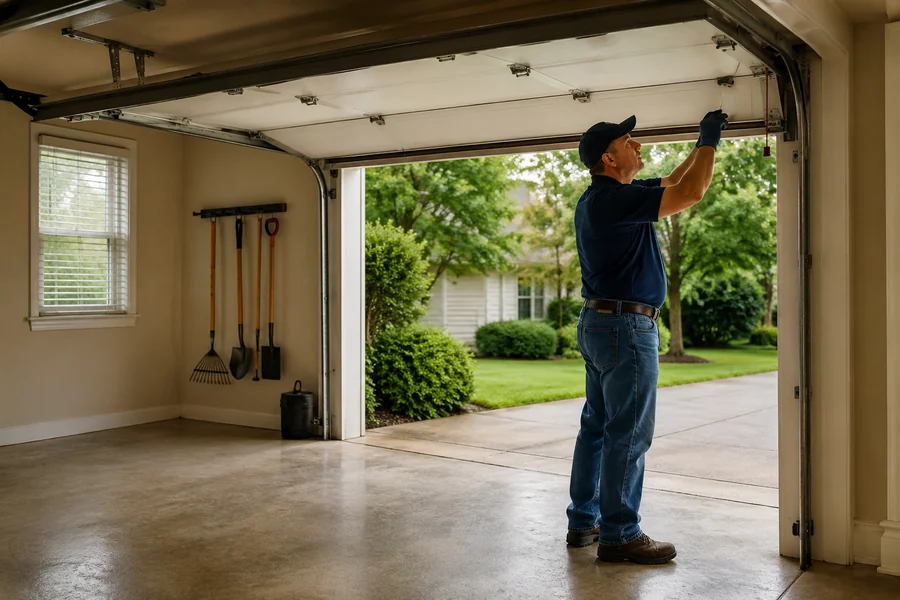
Most people schedule garage door maintenance exactly once: the day it stops working. That approach costs three to five times more than staying ahead of it, and in a state with real hurricane seasons, it can leave your home genuinely exposed. Skipping routine service is not a neutral choice. A neglected door is a failing door, and a failing door is eventually a dangerous one.
This guide gives you a clear, season-by-season rhythm so you always know what to check, what to listen for, and when to call a professional before the situation turns urgent.
Why Maintenance Frequency Actually Matters
Your garage door is the largest moving mechanical system in your home, and it takes punishment on a daily basis. Springs, rollers, cables, and weather seals all wear on a predictable cycle tied to how many times you open and close the door each day.
Consider the springs. Standard torsion springs are rated for roughly 10,000 cycles, which translates to about 7 to 14 years for a household running three to four open-close cycles per day. A busier household, where the garage doubles as the main entry, can burn through that rating in five years or fewer. When the spring goes, the door goes with it, often without warning.
The safety stakes are real, too. According to the U.S. Consumer Product Safety Commission, an estimated 20,000 to 30,000 injuries happen each year due to accidents involving garage doors, at least five of which result in death or serious brain damage annually. The U.S. Consumer Product Safety Commission consistently points to neglected or malfunctioning equipment as a primary contributor to those incidents. Keeping your system in service-ready condition is not just about convenience; it is directly tied to keeping the people in your home safe.
The security angle matters just as much. According to compiled burglary data, 9% of burglars use the garage door as their access point. That figure comes from The Zebra’s 2026 burglary statistics report, which draws on FBI and Department of Justice datasets. A door with worn cables, a sluggish opener, or a compromised bottom seal is a softer target than one that closes tight and locks clean.
The SALT Framework: A Season-by-Season Maintenance Model
Here is a practical structure built around four checkpoints per year. Think of it as the SALT Framework: Spring audit, Autumn prep, Late-summer weather check, and Targeted repair window in early winter. Each checkpoint has a specific purpose tied to what the season demands from your door.
Spring: Full System Audit
Spring is your annual reset. After a winter of temperature swings and condensation cycles, every moving part deserves a close look. This is the checkpoint where you cover everything.
- Test the door balance. Disconnect the opener using the red emergency release cord, lift the door manually to waist height, and let go. A balanced door holds its position. One that creeps down or shoots up has a spring tension problem worth addressing now.
- Inspect all rollers for cracking or flat spots. Nylon rollers wear more quietly than steel but show visible degradation around the wheel edges.
- Check cables for fraying along their entire length, especially near the drums at the top of the door.
- Lubricate springs, hinges, and rollers with a garage-door specific lubricant, not WD-40, which strips rather than coats.
- Test the auto-reverse by placing a two-by-four flat on the ground in the door’s path. If the door does not reverse within two seconds of contact, the opener needs adjustment or replacement.
Summer and Late-Season Weather Check
In the Gulf Coast region, summer is hurricane season. For homeowners relying on overhead door maintenance in Hernando County, Florida, this is the checkpoint that matters most from a structural standpoint. Florida’s building code requires garage doors to meet specific design pressure ratings based on wind zone, and a door that was compliant when installed may have drifted out of spec if hardware has been replaced informally or if the door has sustained subtle storm damage over the years.
Check that weather seals run the full perimeter without gaps or dry-rot cracking. A broken bottom seal is not just a pest and moisture issue. In a high-wind event, even small pressure differentials along the door’s edges compound fast. Look at your door’s product label or paperwork for its design pressure rating and confirm it still matches what your local code requires. If you do not know what that rating should be, a licensed technician can verify it in minutes.
Autumn: Pre-Winter Prep
Florida winters are mild by most standards, but temperature drops still tighten metal components and stiffen lubricants. Run through a targeted checklist before November.
- Reapply lubricant to all moving parts, since summer heat accelerates evaporation.
- Inspect the bottom weather seal for any summer damage from UV exposure.
- Tighten all visible hardware. Vibration from thousands of cycles loosens bolts gradually, and autumn is a good time to go around with a socket wrench before the cold stiffens everything further.
- Test the keypad and remotes. Cold temperatures affect battery performance; swap in fresh batteries now instead of discovering the problem when you are late for work in January.
Early Winter: Targeted Repair Window
This is not a full audit. This is a one-item focus: the opener. Check for hesitation on the first run of the morning, which often signals a motor under stress. Listen for grinding or clicking sounds that were not there in the fall. Garage door openers typically last 10 to 15 years, and a unit approaching that range that is starting to stall in cooler temps is giving you a clean warning.
Component Lifespan at a Glance
| Component | Typical Lifespan | First Warning Sign
|
| Torsion springs | 7 to 14 years | Door feels heavy when opened manually |
| Cables | 5 to 7 years | Visible fraying near the drum |
| Rollers | 5 to 12 years | Grinding or squealing during travel |
| Opener | 10 to 15 years | Hesitation or inconsistent operation |
| Bottom weather seal | 3 to 5 years | Light visible under door when closed |
The table above reflects ranges across typical residential use. Coastal Florida conditions, specifically salt air, UV intensity, and humidity, push every component toward the shorter end of those ranges.
When to Call a Pro vs. Handle It Yourself
There is a clear line between what a homeowner should do and what requires a licensed technician. Lubrication, visual inspection, hardware tightening, and sensor testing are all reasonable DIY tasks. Spring replacement, cable work, and anything involving the torsion bar is not. Springs store enormous amounts of tension; a mishandled release can cause serious injury, and the statistics on garage-door related injuries confirm that many accidents stem from exactly this kind of DIY overreach.
“Routine maintenance helps reduce wear on moving components and allows small issues to be corrected before they become larger problems.” This consensus, echoed across service professionals and industry guidance, frames preventive maintenance not as optional upkeep but as the foundational practice that keeps a door functional across its full potential lifespan of 15 to 30 years.
The practical rule: if a component is under tension or involves electrical wiring, call a technician. Every other task on the SALT Framework is fair game for a motivated homeowner with a half-hour and a can of garage-door lubricant.
Putting It Together
Four checkpoints per year is not a heavy commitment. Two of them, the late-summer weather check and the early-winter opener review, take under 20 minutes. The spring audit runs about an hour. Autumn prep is somewhere in between. Spread across 12 months, you are looking at two to three hours of attention annually in exchange for a system that does not strand you in your own driveway.
If your door is over 10 years old and has never had a professional inspection, that is the right place to start. A technician can establish a component-by-component baseline so every future DIY check actually means something. Which checkpoints in the SALT Framework does your current maintenance routine cover, and which ones have been quietly slipping past you

Hi, I’m Tony — a passionate blogger with over 3 years of experience in writing informative and accurate content. I specialize in sharing practical insights on sizes, measurements, and spatial guides to help readers make confident decisions. Through DimensionsPoint.com, I aim to simplify complex data into easy-to-understand content that’s reliable, useful, and SEO-friendly.
When I’m not writing, I’m researching the latest trends in measurement standards and user needs to keep my content relevant and up to date.