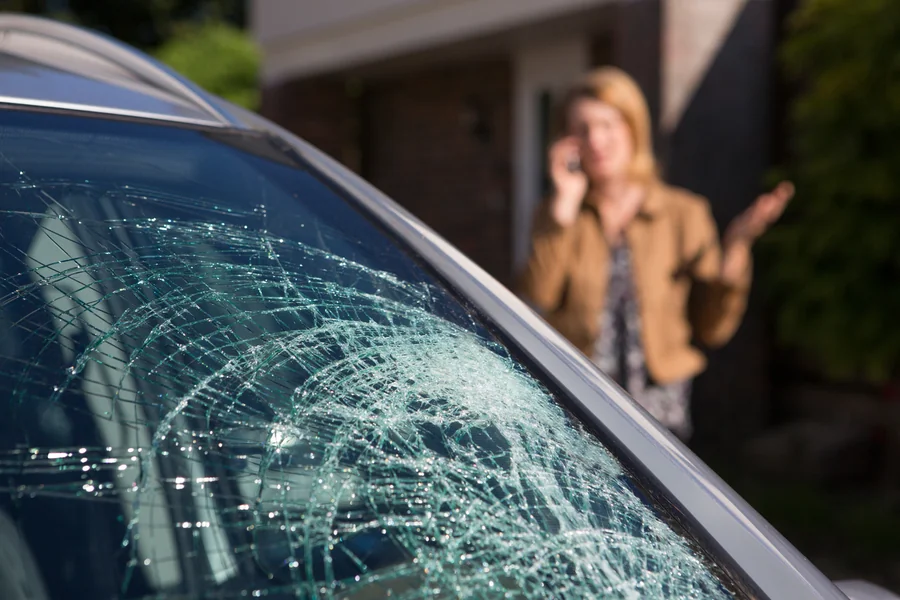
Most drivers see a crack and think: cosmetic problem, fix it eventually. That’s the wrong frame entirely. A windshield is not a window. It is a load-bearing structural panel and a precision optical mount, and the moment it cracks, two separate categories of safety risk start a quiet countdown. One is structural. The other is invisible, electronic, and arguably more dangerous because your dashboard will never warn you about it.
Here’s what’s actually happening inside your vehicle while that crack sits there spreading.
The Structural Story Most People Already Know (But Underestimate)
Your windshield contributes roughly 45 percent of your vehicle’s structural integrity in a frontal collision and up to 60 percent in a rollover. Those numbers come from how laminated auto glass is engineered: two plies of glass bonded by a polyvinyl butyral interlayer, bonded to the body frame with urethane adhesive rated to specific retention forces under Federal Motor Vehicle Safety Standards enforced by the NHTSA, including FMVSS 212 (windshield retention) and FMVSS 219 (windshield zone intrusion).
A crack interrupts the lamination bond. That interruption creates what engineers call a stress concentrator: a point where load redistributes unevenly across the glass surface. Under highway vibration, temperature swings, or even the body flex from a hard turn, that concentrator propagates. A chip smaller than a quarter can travel into a foot-long crack within 48 hours during a Missouri summer, when the glass expands against asphalt-generated heat and then contracts overnight.
The practical result: a cracked windshield that still looks “basically okay” may already have reduced roof crush resistance meaningfully. If the passenger-side airbag deploys and the windshield is structurally compromised, the bag uses the glass as a backstop to direct inflation. A weakened pane can eject outward instead of holding position, rendering the airbag’s geometry completely wrong at the moment you need it most.
That’s the structural category. Serious, but at least visible. The second category is what really deserves your attention right now.
The Silent Failure Window: ADAS and the Problem You Can’t See
If your vehicle is a 2018 model year or newer, there is almost certainly a forward-facing camera mounted to your windshield, typically at the top-center of the glass near the rearview mirror. That camera is the eye for your automatic emergency braking (AEB), lane-keep assist, adaptive cruise, and forward collision warning systems. It was positioned and calibrated at the factory to see the road from a precise angle, measured in fractions of a degree.
When you replace a cracked windshield, the new glass goes in at a fractionally different position than the original. Different adhesive thickness, minor glass tolerance variations, microscopic differences in how the bracket re-seats. All of it matters, because the Auto Glass Safety Council confirms that ADAS systems will not be accurate without recalibration after a windshield installation, and vehicle manufacturers explicitly require it in their OEM service procedures.
But here’s the part that catches drivers completely off guard: a miscalibrated camera will not throw a warning light. The system appears fully functional. Your forward collision icon still lives on the instrument cluster. Adaptive cruise still engages at the tap of a button. Lane departure still beeps occasionally. None of that tells you whether the camera is actually aligned to factory spec.
I call this the Silent Failure Window: the period after a windshield job where your safety systems appear operational but may be running outside their verified parameters. A camera shifted by one degree will misread the distance to the vehicle ahead by several feet at highway range. That misread translates directly into a delayed automatic braking trigger. In stop-and-go traffic on a busy interstate, that delay is the difference between stopping and not stopping.
This is not a fringe scenario. The AAA Foundation for Traffic Safety has documented that driver assistance technologies like forward collision warning, lane keeping assist, and automatic emergency braking could prevent millions of crashes annually if properly functioning. A miscalibrated camera undercuts every one of those benefits, without any warning from the vehicle.
Repair vs. Replace: The Crack Severity Matrix
Not every crack means a new windshield. The decision depends on four variables: size, location, depth, and proximity to the edge. Here’s how to read the damage quickly.
| Damage Type | Size Threshold | Location Factor | Likely Outcome
|
| Bullseye chip | Smaller than a quarter | Outside driver’s direct sightline | Resin repair, 30 min |
| Star crack | Under 1 inch diameter | Away from ADAS camera zone | Resin repair likely |
| Linear crack | Under 6 inches | Not touching edge, not in sightline | Repair possible, inspect first |
| Linear crack | Over 6 inches | Any location | Full replacement required |
| Any damage | Any size | Driver’s direct sightline or edge | Replacement, no exceptions |
| Any damage | Any size | ADAS camera mounting zone | Replacement plus ADAS recalibration |
If your damage qualifies for repair, get it done within 48 hours. Temperature cycling expands the crack daily in warm climates. A repairable chip becomes an irrepairable crack faster than most drivers expect, and a $50 repair turns into a $400 replacement.
What to Ask Before You Book Any Glass Service
Whether you’re looking at a chip repair or a full windshield replacement, four questions should come before you confirm any appointment. Ask each one directly and pay attention to how the shop responds.
- Do you use OEM or OEM-equivalent glass? Aftermarket glass can differ in optical thickness and curvature, both of which affect how the ADAS camera reads the road after installation.
- Do you perform ADAS recalibration in-house? Some shops do the glass and send you elsewhere for calibration, which introduces a gap in the safety chain. A shop that handles both under one roof is the cleaner option.
- What is the safe drive-away time after the urethane cures? Moving the vehicle before the adhesive reaches its minimum retention strength is a genuine FMVSS 212 compliance issue, not just a shop preference.
- Is there a warranty on the workmanship, separate from the glass itself? Leaks and optical distortion after installation are workmanship failures. Know what’s covered before you drive away.
A shop that hesitates on any of those questions is telling you something useful.
The Real Cost of Waiting
People delay glass repairs for two reasons: they think the damage is minor, and they’re not sure insurance covers it. Both are usually wrong. Most comprehensive auto policies cover chips and cracks, often with no out-of-pocket cost. A few states even require insurers to waive the deductible entirely on glass claims.
The actual cost of waiting is the repair-to-replacement conversion. It’s also the ADAS liability: every mile you drive on a cracked windshield with a forward-facing camera is a mile where your automatic safety systems may or may not perform to spec. You won’t know which one it is until you need them.
“A shop that replaces the glass on an equipped vehicle and skips calibration is leaving a safety system in an unverified state.” — Auto Glass Now, citing vehicle manufacturer recalibration requirements, 2026
That’s not vendor language. That’s the industry’s honest read on what skipping recalibration actually means for the driver.
The crack on your windshield is not waiting for you to get around to it. Temperature, road vibration, and door-closing pressure are already working on it. If the damage is small enough to repair, that window closes faster than most people realize. And if it’s already past that threshold, your ADAS camera is sitting at an angle no one has verified since before the new glass went in. That’s the question worth acting on today.

Hi, I’m Tony — a passionate blogger with over 3 years of experience in writing informative and accurate content. I specialize in sharing practical insights on sizes, measurements, and spatial guides to help readers make confident decisions. Through DimensionsPoint.com, I aim to simplify complex data into easy-to-understand content that’s reliable, useful, and SEO-friendly.
When I’m not writing, I’m researching the latest trends in measurement standards and user needs to keep my content relevant and up to date.