
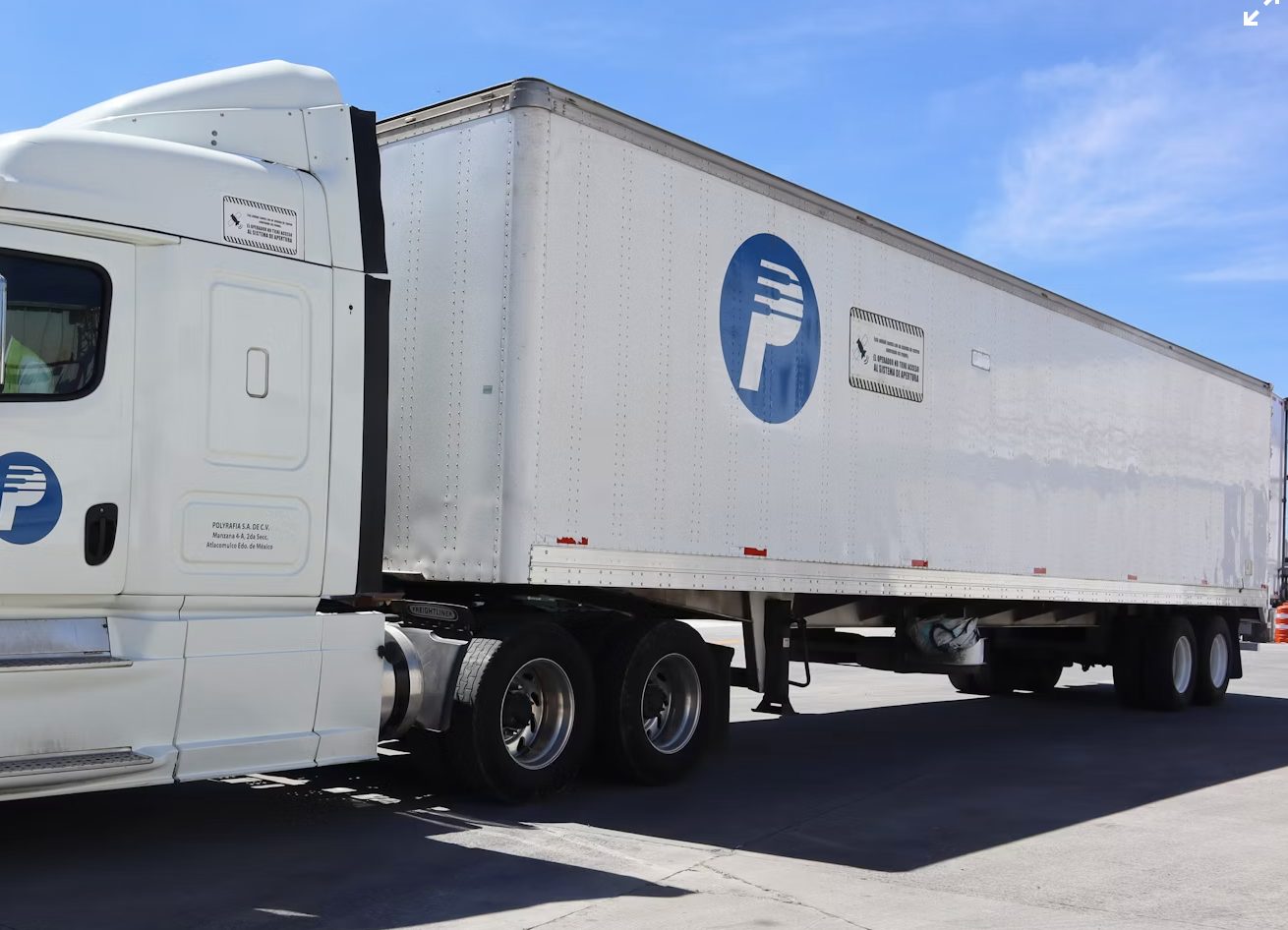
The strawberry in the retail produce case traveled to get there. That journey involved decisions about cold chain management at every transfer point, and each decision either preserved or degraded the product that the retailer eventually sold and the consumer eventually ate. Most of that journey happened inside a refrigerated trailer.
The trailer itself becomes part of the securement equation once the load is on the deck. Its usable deck area, anchor-point locations, surface friction, and the way the cargo is positioned determine how restraint forces reach the trailer.
During braking, cornering, acceleration, or uneven road conditions, those forces do not act on the cargo in isolation. They move through the tie-downs, anchor points, deck, and trailer structure as one system. A flatbed trailer rental therefore introduces more than additional hauling space; its physical configuration becomes part of how the load must be secured.
Hour Zero: Pre-Cooling the Trailer Before Loading
The most common cold chain mistake is loading a warm trailer.
A reefer trailer that has been sitting in a dock yard over a weekend holds the ambient temperature it reached during the weekend. On a July afternoon in Colorado’s agricultural valleys, that temperature is 85 to 95 degrees Fahrenheit inside the trailer, regardless of what the refrigeration unit’s thermostat is set to.
A refrigeration unit set to 34 degrees after days at 90 degrees does not bring the trailer to 34 degrees in 30 minutes. It brings it to 34 degrees in three to six hours depending on the unit’s BTU capacity, the ambient temperature, and whether the trailer doors remain closed during the process.
Produce loaded into a trailer that has not pre-cooled sits in a 60 to 75-degree environment during the first hours of transit, which is the period when microbiological activity on fresh produce is most rapid. The refrigeration unit that is working to bring the trailer to temperature is not maintaining the product. It is fighting the thermal mass of both the trailer walls and the warm product that was loaded into it.
The industry standard, documented in USDA cold chain management guidance, is to pre-cool the trailer to two degrees below the target load temperature before loading begins and to maintain that temperature with the refrigeration unit running during the entire loading process, keeping doors open only during active loading.
The Temperature Mapping Problem
A reefer trailer is not a uniform temperature environment. The air return area near the refrigeration unit at the front of the trailer is coldest. The rear of the trailer, near the doors, is warmest. The temperature differential between front and rear in a fully loaded trailer running at 34 degrees commonly reaches 4 to 8 degrees Fahrenheit.
For products with tight temperature requirements, the product loaded at the rear of the trailer may be experiencing temperatures of 38 to 42 degrees while the same product at the front is held at 34 to 36 degrees. This differential is not a refrigeration unit failure. It is a loading geometry issue.
The correct practice for temperature-sensitive products is to load the highest-sensitivity product at the front of the trailer where temperature is most consistent, and to load insulating spacers or thermal dividers at the rear when load configuration requires rear positioning of sensitive product.
What Happens to Strawberries Specifically Over 24 Hours
Strawberries have a narrow viable temperature range for extended shelf life. California strawberry handlers use a 32 to 36-degree Fahrenheit range as the operational target. Below 32 degrees, cell damage from ice crystal formation begins. Above 36 degrees, respiration rate increases and both flavor compound degradation and microbiological growth accelerate.
At 36 degrees Fahrenheit: respiration rate is approximately half the rate at 50 degrees. Ethylene production, which drives ripening and softening, is low. Shelf life at this temperature from harvest is approximately 10 to 14 days.
At 50 degrees Fahrenheit: respiration rate doubles. Ethylene production increases. Shelf life from harvest drops to approximately five to seven days.
At 60 degrees Fahrenheit: shelf life from harvest is approximately two to three days.
A trailer that failed to pre-cool before loading and allowed a two-hour period of 65-degree exposure during loading on a hot July afternoon cost the shipper approximately two days of product shelf life per pallet, before the product left the origin facility. Those two days cannot be recovered during the remaining transit time.
What Shore Power vs. Diesel Operation Changes About Long-Term Storage Use
When a reefer trailer is used as stationary cold storage rather than for transport, the power source decision affects both operating cost and temperature consistency.
A diesel-powered refrigeration unit running at idle to maintain 34 degrees inside a stationary trailer consumes 0.5 to 1.5 gallons of diesel fuel per hour depending on ambient temperature and door cycle frequency. At 24 hours of operation, that is 12 to 36 gallons per day. At current diesel prices of $3.80 to $4.40 per gallon, the daily operating cost of diesel-powered stationary storage is $45 to $158 per day in fuel alone.
Shore power operation, where the refrigeration unit plugs into a 460-volt three-phase electrical connection, runs the same refrigeration cycle from grid electricity rather than diesel combustion. Operating cost for shore power refrigeration runs $8 to $22 per day in electricity cost at commercial rates.
The difference between diesel and shore power for a 30-day stationary storage rental is $1,100 to $4,080 in operating cost. For stationary applications where shore power is available, the connection reduces total cost of occupancy by 60 to 85 percent compared to diesel operation.
What Door Cycle Frequency Does to Temperature Management
Every time a reefer trailer door opens, the refrigerated air inside the trailer exchanges with ambient air outside. The volume of exchange depends on how long the door is open and the temperature differential between inside and outside.
A fully loaded trailer at 34 degrees opened for 45 seconds on a 90-degree day loses approximately 15 to 20 percent of its refrigerated air volume in that opening event. The refrigeration unit recovers this loss, typically in 8 to 15 minutes at full compressor load.
In a high-frequency access operation where the trailer is opened 20 to 30 times per day, the compressor is in near-continuous recovery mode. This is not a temperature control problem at moderate ambient temperatures. At very high ambient temperatures (above 100 degrees), high door cycle frequency in a small-unit-BTU-capacity trailer produces a situation where recovery is incomplete between door openings and the interior temperature gradually rises above setpoint.
For high-access stationary storage operations in summer conditions, specifying a refrigeration unit with higher BTU capacity than the minimum required for the trailer size provides the recovery buffer that prevents temperature drift during high door-cycle periods.
Key Takeaways
- USDA cold chain guidance specifies pre-cooling trailers to two degrees below target load temperature before loading begins, with refrigeration unit running throughout the loading process
- Temperature differential from front to rear of a fully loaded reefer trailer commonly reaches 4 to 8 degrees Fahrenheit, requiring load position planning for temperature-sensitive product
- Strawberries held at 36°F have a shelf life of 10 to 14 days from harvest. At 50°F, that drops to 5 to 7 days. A two-hour loading exposure at 65°F costs approximately two days of shelf life per pallet before the shipment leaves the origin facility
- Shore power operation costs $8 to $22 per day versus $45 to $158 per day for diesel-powered stationary storage, a 60 to 85 percent reduction in operating cost where shore power is available
- High door-cycle frequency in hot ambient conditions requires over-specified BTU capacity to maintain recovery intervals between openings
Temperature is not preserved by the refrigeration unit alone. It is preserved by every decision in the cold chain sequence, from the moment the trailer is brought to temperature before loading through every door opening during the product’s time inside it.

Hi, I’m Tony — a passionate blogger with over 3 years of experience in writing informative and accurate content. I specialize in sharing practical insights on sizes, measurements, and spatial guides to help readers make confident decisions. Through DimensionsPoint.com, I aim to simplify complex data into easy-to-understand content that’s reliable, useful, and SEO-friendly.
When I’m not writing, I’m researching the latest trends in measurement standards and user needs to keep my content relevant and up to date.