
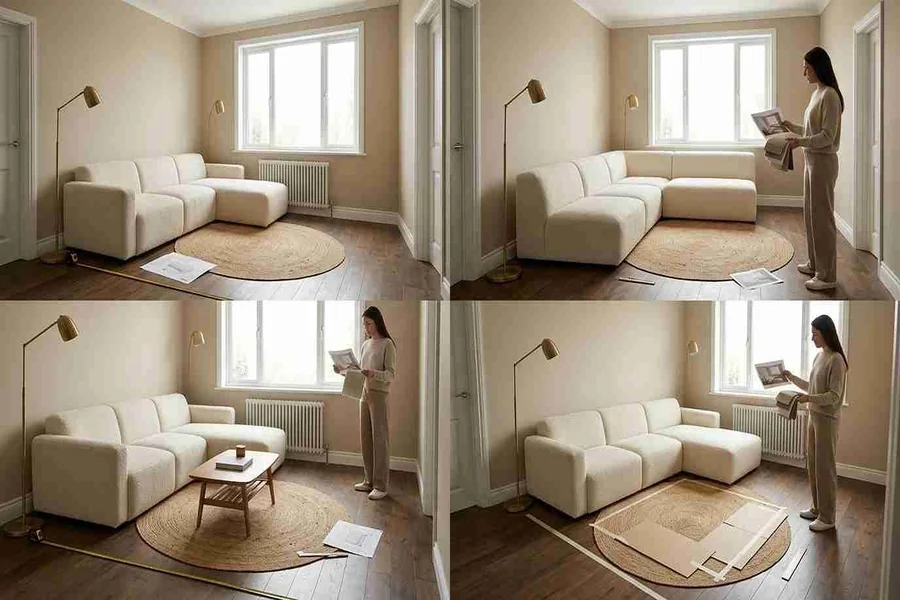
Painter’s tape on the floor has long been the closest thing to a visualization trick for furniture shopping, mark out the footprint, walk around it, and the number on a listing finally stops feeling abstract. It’s a genuinely useful method, but it stops at the floor. Higgsfied with its advanced feature of an AI Image Editor takes that same idea a step further, letting you see the actual piece sitting in your actual room rather than just its outline taped to the carpet, and Higgsfield is one of the tools making that possible.
That gap between knowing a piece’s dimensions and actually knowing how it will look and feel in your space has always been the hardest part of furniture shopping, the part no amount of careful measuring fully solves on its own, no matter how precise the tape measure or how carefully the numbers get double-checked.
Why Do Dimensions Alone Rarely Answer the “Will It Fit” Question?
Three numbers on a listing, length, width, height, tell you whether a piece will physically clear a doorway or sit within a wall’s width. What they don’t tell you is whether that piece will actually feel right once it’s there, whether it overwhelms a small room, clashes with existing furniture, or leaves an awkward gap that only becomes obvious once the delivery truck has already left and gone.
That gap between fitting and feeling right is exactly why so many pieces of furniture get measured carefully, ordered confidently, and then returned anyway. The numbers were correct the whole time. What was missing was a genuine sense of how those numbers would translate into the actual room, with its actual light and its actual existing furniture already in place.
What Has Made Visualizing Furniture in Your Own Space So Difficult?
Techniques like taping off a footprint on the floor genuinely help with the basic question of whether something fits, but they only ever show a flat outline, not the actual height, bulk, or visual weight a piece will bring into a room. A sofa’s footprint might tape off perfectly and still turn out to feel far bulkier in the room than the flat outline ever suggested once it’s actually delivered and sitting there.
Retailer room-planner tools exist for some furniture categories, but they’re typically limited to that one specific retailer’s own catalog and a generic sample room that looks nothing like your actual space, your actual lighting, or your actual existing furniture. For anyone trying to compare a piece from one store against a room that already has other furniture in it, that gap has traditionally had no real solution beyond imagination and a fair amount of guesswork.
How Are AI Image Editors Actually Solving This?
AI image editing addresses this gap directly by letting you upload a photo of your own room and generate a version with a specific piece of furniture placed into it, at the correct scale, in the correct spot. Instead of imagining how a sofa’s dimensions translate into your living room, you can actually see a realistic version of your room with that sofa already in it, before a single order gets placed.
This matters most for exactly the kind of decision dimensions alone can’t answer, whether a piece’s scale, colour, and shape will genuinely work in a room that already has its own furniture, its own lighting, and its own proportions that a generic showroom photo or a taped-off floor outline was never going to capture properly.
How Does Higgsfield Fit Into the Furniture-Buying Decision?
Higgsfield operates as a broader AI creative suite rather than a single-purpose visualization tool, bringing image editing together with generation, video, and upscaling inside one platform. For someone furnishing a room, that range matters because a single decision often involves testing more than one thing at once, a sofa alongside a rug, a dining table alongside new chairs, all of which can be tested together in the same Higgsfield-edited photo rather than one piece at a time in isolation.
Higgsfield gives access to 15 or more leading image models, letting you compare how different models handle a specific material, a tufted fabric sofa behaves differently under different models than a sleek leather one, before settling on whichever result actually looks convincing against your real room. As our own guide on furniture dimensions for every room in your home points out, the fastest traditional way to make a dimension feel real has always been the painter’s tape trick, marking a footprint on the floor and walking around it. AI image editing extends that exact same instinct, seeing something concrete instead of imagining an abstract number, into something you can actually look at rather than just walk around and picture in your head.
What Capabilities Matter Most for Testing Furniture Fit?
A handful of specific features determine whether an AI image editor actually holds up for making a real furniture decision rather than just producing a nice picture.
Placing a Specific Piece Into Your Actual Room Photo
Higgsfield can take a photo of your own room and generate a version with a specific piece of furniture placed into it at the correct scale, rather than a generic stock room that looks nothing like your actual space. That matters directly because your room’s proportions, your existing furniture, and your specific lighting are exactly the variables a listing’s dimensions were never designed to communicate on their own, no matter how carefully they were measured.
Testing Multiple Pieces or Placements Before Committing
Because generation happens in minutes rather than requiring a physical delivery to test, you can generate a few different placement options or compare two similar pieces against the same room photo before making any final decision. That kind of testing has traditionally meant ordering one option, living with it, and possibly returning it if it didn’t work, an expensive and inconvenient way to answer a question a quick visual comparison can now settle upfront before any money actually changes hands.
Getting a Result Sharp Enough to Actually Judge Scale
Higgsfield supports native output at up to 4K resolution, which matters when you’re trying to genuinely judge whether a piece looks proportionate in a room rather than just glancing at a small, low-resolution preview. Being able to zoom in and study how a piece actually sits against your existing furniture and wall space is a meaningfully different experience from a blurry, low-detail mockup that leaves just as much to guesswork as the original dimensions did.
Does This Actually Cut Down on Furniture Returns?
This is worth addressing directly, since furniture returns have always been a genuine cost, both the delivery and pickup fees many retailers charge and the sheer hassle of coordinating a return around an already busy schedule. A piece that measured correctly but simply looked wrong once it arrived is one of the most common reasons a return happens in the first place, even when nothing about the purchase was technically a mistake.
Testing a piece against your actual room photo through Higgsfield before ordering shifts that decision earlier, when it costs nothing but a few minutes, rather than after a delivery, when it costs a return fee and a second wait for a replacement. That shift matters most for larger, more expensive pieces where a wrong decision is expensive to undo and genuinely inconvenient to live with in the meantime, and where Higgsfield’s ability to test several options side by side pays for itself against even a single avoided return.
How Does This Compare to Measuring and Taping Off a Footprint?
The practical difference between the traditional measure-and-tape approach and generating a visualization through an AI image editor becomes clear once you’re trying to judge more than just whether something physically fits, and it’s exactly the gap Higgsfield is built to close.
| Factor | Measuring and Taping a Footprint | AI Image Editing with Higgsfield |
| What it shows | A flat outline on the floor | The actual piece, at scale, in your real room |
| Judging visual weight and proportion | Left entirely to imagination | Visible directly in the generated image |
| Testing against existing furniture and colour | Not possible without physically staging it | Shown together in the same edited photo |
| Comparing multiple options | Requires retaping for each option | Multiple versions generated from the same room photo |
| Best suited for | Confirming a piece will physically clear the space | Judging whether a piece will actually look and feel right |
That comparison doesn’t make measuring and taping useless, it remains the fastest, simplest way to confirm a piece will physically clear a doorway or a wall width. What an AI image editor adds is the harder, more subjective part of the decision, whether a piece that technically fits will actually look right once it’s there, a question dimensions alone have never been able to answer no matter how precisely they were measured.
Who Gets the Most Value Out of This?
Anyone furnishing a small or awkwardly shaped room benefits most obviously and directly, since the margin for a piece feeling wrong, even when it technically fits, is much narrower in a tight space than in a large, forgiving one with plenty of room to spare. Shoppers comparing similar pieces from different retailers benefit particularly, since a generated visualization lets you compare options against the exact same room photo rather than mentally combining separate showroom images from different websites and hoping the comparison holds up.
Anyone who has been burned by an online furniture return, ordering something that measured correctly but looked wrong once delivered, has a direct reason to test a tool like Higgsfield before the next purchase. People furnishing a room sight unseen, moving into a new home before visiting in person, or shopping for a space they can only access through photos, also stand to benefit from a tool that lets them test decisions remotely rather than guessing from measurements alone and hoping for the best once it finally arrives.
How Can You Actually Try This Before Your Next Purchase?
Higgsfield is free to start with, offering daily generation credits that let you test the platform on a single upcoming purchase before deciding whether it’s worth building into your regular shopping process. A practical starting point is taking a clear photo of the actual space you’re furnishing and generating a version with the specific piece you’re considering, comparing that against the retailer’s own product photo alone before you actually place an order.
If you’re choosing between a couple of similar options, testing both against the same room photo tends to make the decision far clearer than trying to hold two separate product listings in your head and imagine which one would actually work better in the space you have available. A side-by-side comparison generated from your own room removes the guesswork that usually happens when you’re switching between browser tabs trying to picture two different pieces in the same spot.
What’s the Bottom Line for Furniture Shoppers?
Dimensions have always told you whether something will physically fit, but they’ve never been able to tell you whether it will actually look right once it’s there, and that gap has been responsible for a genuinely large share of furniture returns and buyer’s remorse over the years. AI image editing tools don’t replace the value of careful measuring, they handle the part measuring was never built to answer, whether a piece that fits will also feel right.
For anyone who has ever stood in a room with a tape measure, confident the numbers worked, and still ordered the wrong thing anyway, that’s exactly the gap worth closing before the next purchase gets made rather than after it arrives. Platforms like Higgsfield are becoming part of how that gap gets closed for shoppers who’ve been burned by a listing’s numbers before, whether they realized they were being burned by the numbers or simply assumed they’d made a mistake in their own judgment somewhere along the way.

Hi, I’m Tony — a passionate blogger with over 3 years of experience in writing informative and accurate content. I specialize in sharing practical insights on sizes, measurements, and spatial guides to help readers make confident decisions. Through DimensionsPoint.com, I aim to simplify complex data into easy-to-understand content that’s reliable, useful, and SEO-friendly.
When I’m not writing, I’m researching the latest trends in measurement standards and user needs to keep my content relevant and up to date.